


.png)
.png)

 (1).png)


Commercial Rooftop Solar ROI Explained for Businesses in India
Commercial Rooftop Solar ROI Explained
Electricity expenses have become one of the biggest operational costs for businesses across India. Whether it is a manufacturing unit, warehouse, office building, hotel, hospital, school, or shopping mall, rising power tariffs directly affect profitability. This is exactly why more businesses are shifting toward solar energy. Today, companies are no longer asking whether solar works. Instead, they want to understand one thing clearly — what is the actual Commercial rooftop solar ROI and how quickly can the investment generate returns?
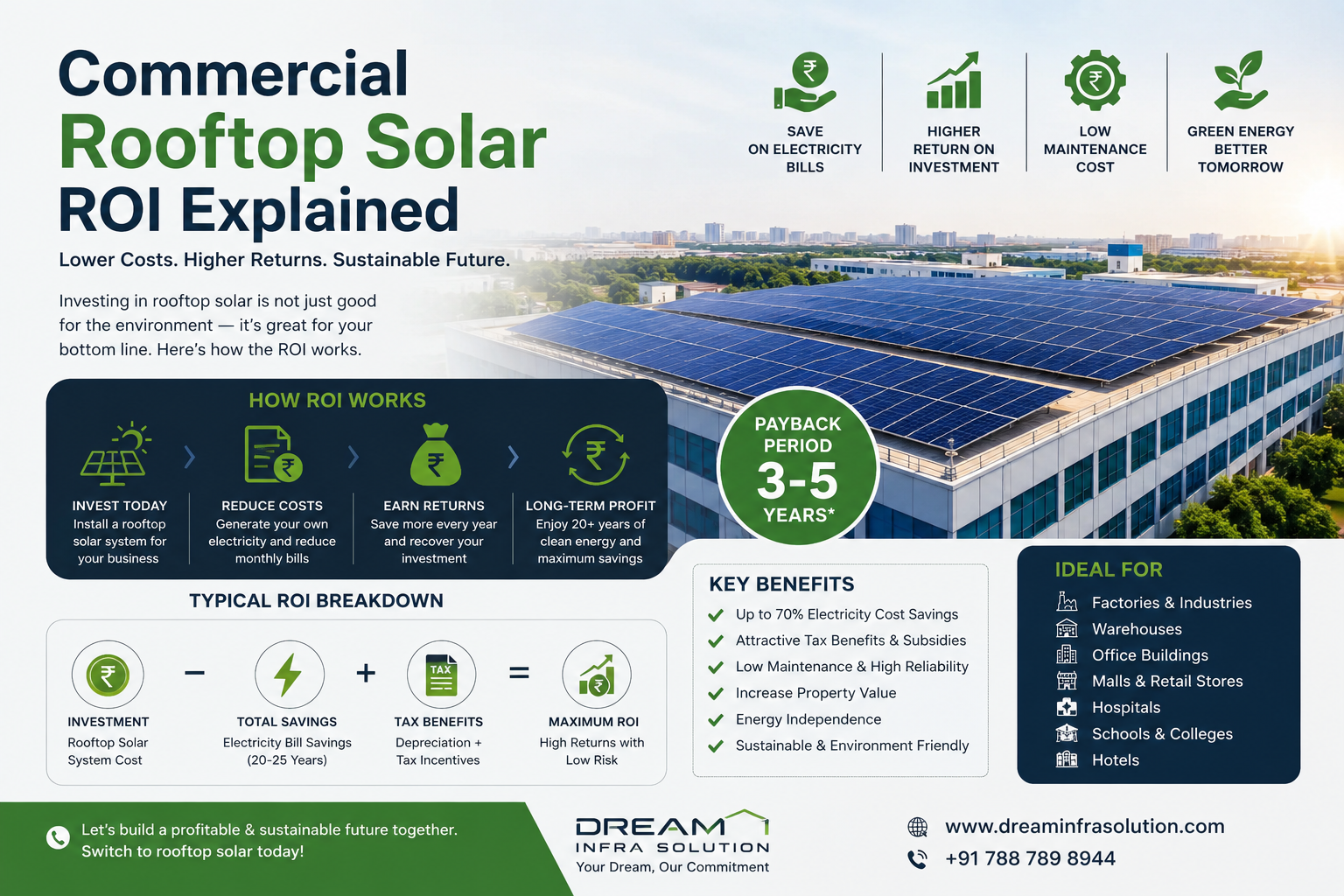
The answer is surprisingly positive. A well-designed Commercial rooftop solar system can reduce electricity bills by up to 70% while generating long-term financial returns for over 25 years. Businesses that invest in solar today are not only lowering operating expenses but also protecting themselves from future electricity price hikes.
In simple words, Commercial solar ROI refers to the financial return a business earns after installing a solar power system on its rooftop. It measures how much money the company saves compared to the cost of installation and maintenance. The higher the savings and the lower the operational expenses, the stronger the return on investment becomes.
For Indian businesses, solar has become more attractive than ever because of government support, falling equipment prices, accelerated depreciation, net metering policies, and financing options. This combination has made Commercial solar return on investment one of the strongest investment opportunities available for industrial and commercial property owners.
Businesses across sectors are adopting Rooftop solar for businesses because it delivers predictable energy costs and long-term financial stability. Unlike diesel generators or rising grid tariffs, solar energy provides clean electricity with minimal recurring costs.
The biggest reason companies choose solar is the huge reduction in electricity expenses. Modern systems deliver substantial Commercial rooftop solar savings every month. For factories and offices with high daytime electricity consumption, the savings can be extraordinary. Many companies recover their investment within three to five years and continue generating savings for the next two decades.
When calculating Commercial solar panel cost savings, businesses should evaluate factors such as current electricity consumption, rooftop space, tariff rates, sunlight availability, and system size. Companies operating in energy-intensive sectors often achieve faster returns because their electricity bills are already high.
In industries where energy consumption runs continuously, Industrial solar ROI becomes even more attractive. Manufacturing plants, textile units, cold storage facilities, pharmaceutical companies, and processing units can save lakhs or even crores annually through solar adoption.
Today, Business solar ROI is not just about reducing bills. It is also about improving operational efficiency, strengthening sustainability goals, and increasing long-term asset value. Companies that adopt solar energy are viewed as environmentally responsible brands, which also improves customer trust and investor confidence.
One of the most important questions businesses ask is about the Commercial solar payback period. This refers to the amount of time required to recover the initial investment through electricity savings. In India, most commercial solar systems achieve payback within three to six years depending on the project size, financing model, and subsidy eligibility.
After the payback period ends, the electricity generated becomes virtually free. This is where the real Commercial solar investment benefits begin. Businesses continue saving money every month while operating expenses remain low.
The financial advantage becomes even stronger because of increasing Commercial solar electricity savings year after year. Electricity tariffs in India continue to rise, but solar energy helps businesses stabilize costs. This creates predictable budgeting and protects companies from unexpected utility price hikes.
For businesses planning long-term expansion, investing in a Commercial solar power system is often smarter than relying entirely on conventional power sources. Solar systems can be scaled based on future energy needs, making them a flexible and future-ready solution.
The actual Commercial solar installation cost depends on several factors including system capacity, panel technology, inverter quality, mounting structure, and installation complexity. However, declining equipment prices have made solar significantly more affordable than it was a decade ago.
Apart from direct savings, businesses also enjoy multiple Commercial solar financial benefits such as accelerated depreciation, tax deductions, improved ESG performance, and reduced operational risks. These financial advantages improve overall project feasibility.
One major reason behind the growth of Commercial solar energy savings in India is supportive government policy. Various state and central government schemes encourage businesses to adopt solar energy through subsidies and incentives.
Many businesses are unaware of the available Commercial solar tax benefits that can dramatically improve project ROI. Accelerated depreciation allows companies to claim significant tax savings in the initial years of installation, improving cash flow and reducing taxable income.
In addition, the availability of Commercial solar subsidy India programs helps reduce upfront investment costs for eligible projects. Government initiatives supporting renewable energy adoption have accelerated solar growth across commercial and industrial sectors.
A professionally designed Commercial rooftop solar system includes solar panels, inverters, mounting structures, cables, monitoring systems, and safety components. Proper engineering and installation are critical because system efficiency directly affects ROI.
Choosing the right partner for Commercial solar panel installation is equally important. A poorly installed system may reduce energy generation and increase maintenance costs over time. Businesses should always work with an experienced EPC company that understands commercial project requirements.
Many companies hesitate because they believe solar requires a huge upfront investment. However, modern Commercial solar financing solutions have made adoption easier than ever. Businesses can choose CAPEX, OPEX, leasing, or power purchase agreement models depending on their budget and operational goals.
A strong Commercial solar project ROI depends heavily on proper feasibility analysis. Before installation, companies should evaluate energy consumption patterns, rooftop strength, shading analysis, and future expansion plans.
Today, several businesses use a Solar ROI calculator commercial tool to estimate potential savings and returns before installation. These tools help calculate energy generation, electricity bill reduction, payback period, and long-term profits.
While solar systems require minimal upkeep, businesses should still consider Commercial solar maintenance cost during financial planning. Routine cleaning, periodic inspections, and inverter maintenance ensure maximum efficiency and longer system life.
A detailed Commercial solar cost analysis helps businesses understand total investment, operational savings, tax incentives, financing costs, and projected returns over the system lifespan.
As demand grows, more companies are exploring advanced Commercial solar energy solutions tailored for specific industries. Factories require high-capacity systems, while offices may prioritize aesthetics and space optimization.
Today, Commercial solar for factories has become one of the fastest-growing sectors in India because manufacturing industries consume enormous amounts of electricity. Solar helps factories reduce production costs and improve competitiveness.
Similarly, Commercial solar for warehouses is highly effective because warehouses usually have large unused rooftop areas ideal for solar installations.
Modern office buildings are also adopting Commercial solar for offices to reduce operational expenses while achieving sustainability targets. Companies using renewable energy often attract environmentally conscious clients and investors.
Retail spaces and shopping centers are rapidly investing in Commercial solar for malls to reduce energy costs from lighting, HVAC systems, escalators, and food courts.
Healthcare institutions are increasingly choosing Commercial solar for hospitals because uninterrupted electricity is critical for medical equipment and patient care.
Educational institutions are also benefiting from Commercial solar for schools by reducing electricity bills and promoting sustainability awareness among students.
The hospitality sector has witnessed strong adoption of Commercial solar for hotels because hotels consume high amounts of electricity for air conditioning, kitchens, lighting, and laundry operations.
One important factor that significantly improves ROI is Commercial solar net metering. This policy allows businesses to export excess electricity to the grid and receive credits on their electricity bills.
Improving Commercial solar energy efficiency is essential for maximizing returns. High-quality panels, advanced inverters, and smart monitoring systems help businesses generate more electricity from available rooftop space.
Modern solar technology has improved Commercial solar panel benefits substantially. Panels today are more durable, efficient, and capable of performing well even in challenging environmental conditions.
The average Commercial rooftop solar cost India depends on project size and system quality, but overall installation costs have become increasingly competitive in recent years.
Businesses searching for the Best commercial solar company should focus on experience, engineering expertise, project execution capability, after-sales support, and long-term service reliability.
Understanding the Commercial solar system price is important, but businesses should also evaluate system quality and lifetime performance rather than choosing the cheapest option.
A proper Commercial solar installation guide helps businesses understand the complete process from feasibility study and design to approvals, installation, and commissioning.
Government-backed Commercial solar tax incentives further improve project viability and accelerate investment recovery.
Another major financial advantage comes through Commercial solar depreciation benefits, which allow businesses to reduce taxable income significantly during the initial years.
Today, many companies are integrating solar into their overall Commercial solar business model to improve operational sustainability and profitability.
Advanced tools such as a Commercial solar investment calculator help businesses estimate lifetime savings and ROI more accurately.
Before installation, a professional Commercial solar energy audit helps identify energy consumption patterns and optimize system design.
Modern technology has improved Commercial solar panel efficiency, allowing businesses to generate more electricity from limited rooftop areas.
A customized Commercial solar system design ensures maximum energy generation and long-term operational performance.
Before investing, businesses should conduct a Commercial solar feasibility study to evaluate technical, financial, and operational viability.
Many organizations now choose structured Commercial solar project financing to reduce upfront investment burden while immediately benefiting from energy savings.
Working with an experienced Commercial solar EPC company ensures smooth execution, compliance, and long-term reliability.
Several states also offer Commercial rooftop solar subsidy schemes that further reduce project costs.
The long-term Commercial solar rooftop benefits extend beyond cost savings. Solar energy improves energy independence, enhances brand image, and supports sustainability goals.
Large-scale projects often involve a dedicated Commercial solar power plant capable of supplying significant portions of industrial electricity demand.
An Industrial rooftop solar system is particularly effective for factories with large roof spaces and continuous daytime operations.
Choosing the right Commercial solar installation company is critical because installation quality directly affects system performance and ROI.
Advanced monitoring software now supports better Commercial solar energy management, allowing businesses to track performance and optimize energy usage.
Massive Commercial solar electricity bill savings are one of the strongest reasons businesses continue investing in solar technology.
Reliable Commercial solar power generation helps businesses reduce dependence on unstable grid electricity and expensive diesel generators.
Regular Commercial solar system maintenance ensures optimal performance and protects long-term investment value.
A professionally executed Commercial solar rooftop installation can operate efficiently for over 25 years with minimal maintenance.
Businesses frequently use a Commercial solar panel ROI calculator to compare projected savings against installation costs.
The overall Commercial solar installation process includes site assessment, system design, government approvals, installation, testing, and commissioning.
Today, multiple Commercial solar financing options are available for businesses of all sizes, making solar adoption easier and more accessible.
The final Commercial solar project cost depends on capacity, equipment quality, engineering complexity, and installation location.
Large industries increasingly prefer Commercial solar system for industries because solar significantly lowers operational expenses and improves long-term profitability.
India has emerged as a major market for Commercial solar solutions India because of strong government support and rising electricity demand.
Supportive Commercial solar policy India initiatives continue driving rapid growth in commercial and industrial solar adoption.
Many state governments also provide Commercial solar government subsidy programs to encourage renewable energy investments.
Businesses should also evaluate Commercial solar panel lifespan and long-term durability before selecting equipment.
A strong Commercial solar panel warranty ensures better protection and long-term reliability.
The cost of inverters also plays an important role in overall ROI, making Commercial solar inverter price an important consideration during project planning.
Some businesses now integrate Commercial solar battery storage to improve energy backup and maximize self-consumption.
Professional Commercial solar energy consultants help businesses design cost-effective and high-performance solar systems.
A reliable Commercial solar system ROI calculator provides accurate financial projections and helps businesses make informed investment decisions.
Today, solar is no longer viewed as an expense but as a smart Commercial solar energy investment with long-term returns.
A detailed Commercial solar rooftop guide helps businesses understand the technical, financial, and operational aspects of solar adoption.
The long-term Commercial solar installation benefits include lower operating costs, energy independence, and improved environmental responsibility.
As electricity prices continue rising, solar offers exceptional Commercial solar investment opportunities for forward-thinking businesses.
Reliable Commercial solar electricity generation helps businesses maintain operational continuity while lowering power expenses.
Modern businesses increasingly prefer Commercial solar system for office buildings because offices consume substantial daytime electricity.
Many companies now use a Commercial solar savings calculator to estimate annual savings and future ROI.
Available Commercial solar tax credit programs further improve investment returns for eligible businesses.
Experienced Commercial solar project developers help businesses execute projects efficiently while ensuring regulatory compliance.
Many businesses now prefer complete Commercial solar turnkey solutions that include design, engineering, procurement, installation, and maintenance.
Regular Commercial solar rooftop maintenance helps ensure consistent energy generation and system reliability.
A successful Commercial solar plant installation can transform electricity from a recurring expense into a long-term financial asset.
Ultimately, the biggest advantage is long-term Commercial solar business savings that continue for decades.
Flexible Commercial solar rooftop financing models now allow businesses to adopt solar without large capital investments.
Strong Commercial solar energy return makes solar one of the most profitable infrastructure investments for modern businesses.
Businesses should carefully evaluate Commercial solar panel installation cost alongside projected savings and system performance.
A high-quality Commercial solar panel system delivers reliable energy generation and excellent long-term ROI.
Advanced Commercial solar solutions for factories are helping manufacturers reduce production costs and improve competitiveness.
The shift toward Commercial solar renewable energy is not only environmentally responsible but also financially rewarding.
Understanding Commercial solar cost per kW helps businesses compare system pricing more effectively.
The primary goal of solar adoption is achieving significant Commercial solar energy cost reduction while improving sustainability.
Professional Commercial solar project management ensures smooth execution and timely project completion.
Today, leading Commercial solar companies India are helping businesses transition toward cleaner and more affordable energy solutions.
The long-term Commercial solar energy benefits extend far beyond electricity savings. Solar helps businesses build resilience, sustainability, and operational efficiency.
Rapidly evolving Commercial solar rooftop trends indicate that commercial solar adoption will continue accelerating in the coming years.
The growing Commercial solar market India reflects increasing awareness about renewable energy and long-term cost savings.
Proper Commercial solar project planning is essential for maximizing ROI and ensuring operational success.
Modern Commercial solar energy systems are more reliable, efficient, and financially attractive than ever before.
Businesses across sectors are increasingly adopting advanced Commercial solar power solutions to improve profitability and energy security.
Ultimately, a successful Commercial rooftop solar investment delivers financial savings, operational stability, environmental benefits, and long-term business growth.
For companies looking to reduce electricity expenses while building a sustainable future, the financial logic is clear. The long-term Commercial rooftop solar benefits make solar one of the smartest investments any business can make today.
If your business is planning to invest in commercial solar energy, Dream Infra Solution can help you design the right system based on your energy requirements, budget, and long-term goals.